When Baron Castiel dies under suspicious circumstances, his young widow Elara is about to lose everything — his title, his estate, and the orphanage she built on his lands. The law says a widow can retain her late husband's holdings only if she remarries within the barony. The only eligible nobleman? The baron's estranged younger brother, a knight who left home years ago and swore never to return. He agrees to a paper marriage — but only until they find who killed his brother.
Get a reply within 24 hours
Sign in to submit feedback
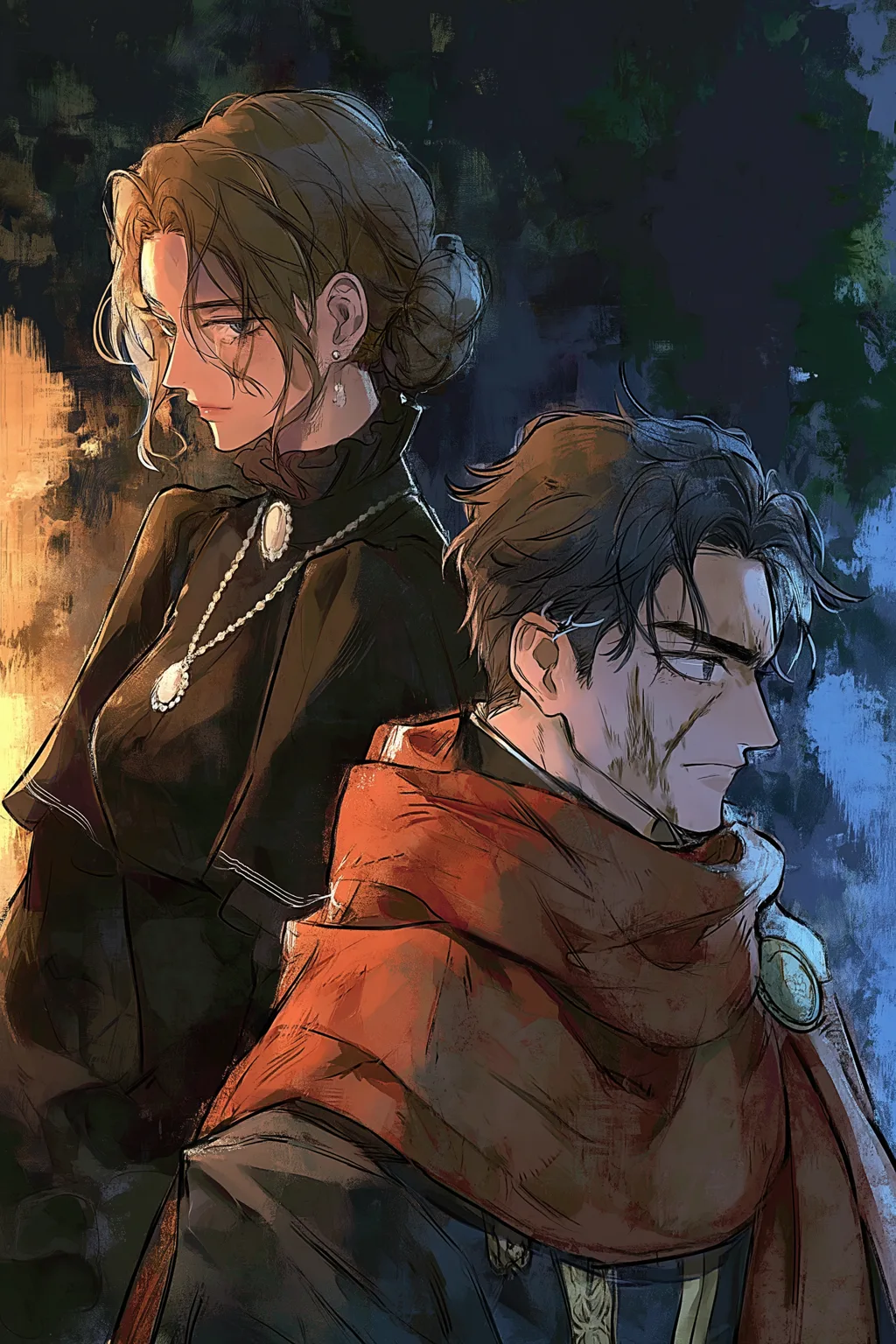
The Baron's Widow
by unsent.ducael
Chapter 1
Chapter 1 - The Widow's Count
The last mourner left at noon.
Elara stood at the edge of the grave as the groundskeeper filled it, each shovelful of earth landing with a sound like a closing door. The autumn wind pulled at her black veil, but she didn't bother holding it down. There was no one left to perform for.
Baron Castiel Voss was dead at twenty-seven.
The priest had spoken of divine mercy and the promise of reunion. The mourners had wept — or pretended to. Lady Thornton had actually swooned, which Elara found impressive given that the woman had met Castiel exactly twice. The magistrate from the capital had attended in his formal robes, watching the proceedings with the detached interest of a man already calculating property transfers.
And now they were all gone, back to their warm carriages and their living husbands, and Elara was alone with the dirt and the wind and the unbearable quiet.
"You could have warned me," she said to the grave.
The grave said nothing.
She pressed her fingers against her eyes until she saw sparks. She would not cry. Not here, not where the groundskeeper could see and report to the servants, who would whisper to the townspeople, who would say the poor widow is falling apart in voices that meant she won't last a month.
She would last a month. She would last a year. She would last as long as Thornmere needed her, because Castiel had asked her to, and she had never broken a promise to him.
Even if he'd apparently been keeping secrets from her.
The manor was too quiet without him.
It had always been a large house for two people — three stories of grey stone overlooking the River Ashen, built by Castiel's grandfather in an era when the Voss family had higher ambitions and deeper coffers. Half the rooms were closed off now, their furniture draped in white sheets like rows of crouching ghosts.
Elara walked the main corridor with the practiced efficiency of a woman who had run this household for five years. Past the portrait gallery, where generations of Voss men stared down with the same sharp jaw and dark eyes. Past the drawing room, where Castiel used to read by the fire while she worked on the estate ledgers across from him, the two of them existing in comfortable silence.
Past the children's wing — her addition. She could hear them through the heavy doors: the muffled shouts and laughter of the Lark House orphans, twelve children who had nowhere else to go until she'd converted the manor's unused east wing into something that mattered.
She paused outside the door. Luc's voice rose above the others, bossy and bright, organizing some game or argument. He was twelve and already acted like a tiny general. The children didn't know yet. She'd have to tell them soon.
Not today.
She kept walking until she reached Castiel's study.
The door was locked. She had the only key now — Maren had pressed it into her palm that morning with a look that said be careful. Maren always looked like that. It was usually warranted.
Elara turned the key and stepped inside.
The study smelled like him. Old paper, ink, the faint sweetness of the herbal tea he drank for his lungs. His desk was cluttered — unusual for a man who kept everything else in precise order. Books stacked unevenly, correspondence half-sorted, a quill left out as if he'd been interrupted mid-sentence.
She'd been avoiding this room since he died. Not from grief, though there was plenty of that. From something sharper: the feeling that if she looked too closely at the mess he'd left behind, she'd find something she couldn't un-find.
Elara sat in his chair. It was too large for her, built for his broad frame, and her feet barely touched the floor. She pulled the nearest stack of papers toward her and began to read.
Correspondence with merchants — routine. Tax records — in order. A letter from Viscountess Isolde Vane offering condolences in language so formal it could have been written by a solicitor.
And then, wedged between two ledgers as if hidden in haste, a single sheet of heavy paper.
She recognized it immediately. Not the handwriting — that was Castiel's, cramped and urgent, written quickly. What she recognized was the paper itself. Thick, cream-colored, with a watermark she'd seen only once before: in the personal stationery of the old baron, Castiel's father.
Aldric Voss had been dead for three years.
His stationery should have been packed away or destroyed. Castiel had cleared his father's belongings within a month of the funeral — almost frantically, now that she thought about it. So why was he writing on his father's paper?
She smoothed the letter flat on the desk and read.
Elara —
If you are reading this, I have run out of time. I am sorry. I should have told you sooner, but I thought I could handle it alone, and I was wrong. I have been wrong about many things.
The barony is not safe. What Father left behind is not what it seems. The payments — you will find the records if you look — go back further than my tenure. I tried to stop them. That may be what kills me.
Whatever happens, protect the children. Protect Thornmere. And above all —
Do not trust
The last two words bled into a dark smudge, as if the ink had been smeared before it dried. Or as if someone had deliberately obscured what came next.
Elara read the letter three times.
Her hands were steady. Her breathing was even. Five years of managing a barony, of negotiating with merchants twice her age, of smiling through insults from nobles who thought a knight's daughter had no business wearing a baroness's ring — five years of that had taught her how to keep her composure while her mind raced.
Castiel hadn't died of illness.
She'd suspected. The physician had called it a failure of the lungs — plausible, given Castiel's history of weakness. But the timing was wrong. He'd been getting better in the months before his death, stronger than she'd seen him in years. And then, in the span of a single night, he was gone.
She folded the letter carefully and slipped it into the hidden pocket sewn into her mourning dress — a pocket she'd added herself, because a woman in her position learned quickly that some things should stay close to the skin.
A knock at the door.
"My lady?" Maren's voice, carefully neutral. "The magistrate is requesting a word before he departs."
Elara closed her eyes. The magistrate. The succession. The thirty-day clock that started ticking the moment they put Castiel in the ground.
"Tell him I'll be down in a moment."
She stood, smoothed her dress, and took one last look at the desk. At the mess Castiel had left behind — not out of carelessness, she realized now, but out of desperation. He'd been trying to leave her a trail.
She locked the study door behind her and went to hear the terms of her own expiration.
The magistrate was a thin man named Pareth who wore his authority like an ill-fitting coat. He stood in the drawing room with his hands behind his back, examining the family portraits with the expression of someone appraising livestock.
"Lady Castiel," he said, turning as she entered. He didn't bow. That told her everything about how the next few minutes would go. "My condolences, once again."
"Thank you, Magistrate. You mentioned there were matters to discuss."
"Indeed." He produced a scroll from his case — the seal of the Crown's Office of Titles, unbroken until this moment. "Per the Succession Act of the Forty-Third Year, a widow may retain her late husband's holdings and title only if she remarries within the same noble house within thirty days of the title-holder's death."
Elara already knew this. She'd read the law six times in the past week. But she let him speak, because men like Pareth needed to feel they were delivering information rather than confirming it.
"If no such marriage occurs," he continued, "the title and holdings revert to the nearest eligible blood relative." He paused, letting that land. "In this case, that would be Viscountess Isolde Vane."
"I'm aware."
"There is, I'm told, one surviving male member of House Voss." Pareth's eyebrows rose. "A younger brother? Rowan, I believe?"
"Yes."
"And where might he be?"
Elara kept her expression pleasant and empty, a skill she had perfected. "I don't know. He left Thornmere ten years ago. We've had no contact."
"Ah." Pareth made a note in his ledger. "That is... unfortunate. Thirty days, my lady. The Viscountess has already filed her intent to claim."
Of course she had. Isolde moved fast. Elara had expected nothing less.
"I understand, Magistrate. Thank you for making the journey."
She walked him to his carriage herself — a courtesy he didn't deserve but that the townspeople would notice. See how composed she is. See how proper. Image was currency in a barony, and she couldn't afford to spend it carelessly.
When his carriage disappeared down the river road, she let out a breath she'd been holding since the funeral.
Thirty days.
She found Maren in the kitchen, already brewing tea with the grim efficiency of a woman preparing for a siege.
"How bad?" Maren asked without turning around.
"Thirty days to remarry within the house, or Isolde takes everything."
"That woman." Maren set a cup down harder than necessary. "She's been circling this estate like a crow since before your husband was cold."
"She filed her claim before the funeral."
Maren's jaw tightened. "So we need Rowan."
"We need Rowan."
"The boy who swore on his mother's grave he'd never set foot in Thornmere again."
"That's the one."
They looked at each other across the kitchen — two women who understood exactly how precarious their world had become. Maren had been with the Voss household for thirty years. If Isolde took over, she'd be dismissed within a week. They all would.
"I'll send riders," Elara said. "Every tavern, every guild hall, every mercenary post between here and the capital. Someone knows where he is."
"And if he won't come?"
Elara thought of the letter in her pocket. Of the smudged name. Of the payments Castiel had mentioned — records she hadn't found yet, hidden somewhere in that cluttered study.
"Then I'll give him a reason to."
She sat down at the kitchen table, pulled a fresh sheet of paper toward her, and began to write.
Rowan Voss —
We have not met. I was your brother's wife. I am sorry to tell you this in a letter, but Castiel is dead.
She paused, then added the only line that mattered.
Your brother did not die of illness. Come home.
She sealed it, stamped it with the Voss crest — her crest, for twenty-nine more days — and handed it to Maren.
"Send the fastest rider we have."
Maren took the letter and left without another word.
Elara sat alone in the kitchen, listening to the fire crack and the children laughing in the east wing, and began to count the days.
Vote to continue this story
When Baron Castiel dies under suspicious circumstances, his young widow Elara is about to lose everything — his title, his estate, and the orphanage she built on his lands. The law says a widow can retain her late husband's holdings only if she remarries within the barony. The only eligible nobleman? The baron's estranged younger brother, a knight who left home years ago and swore never to return. He agrees to a paper marriage — but only until they find who killed his brother.